Article
Aug 10, 2026
Agent Memory: How Agentic Systems Remember, Forget, and Learn

Imagine an assistant that helps you every day.
Now imagine it forgets you every night.
Every morning, you'd explain your routine again. Your preferences again. The fact that you take the stairs, not the elevator, because the elevator in your building is unreliable. Every conversation would start from zero.
That's what most AI systems have been, until recently: brilliant in the moment, and blank the moment after.
Agent memory is the piece that changes that.
From Stateless to Stateful
A stateless system treats every interaction as the first one. It has no record of what happened five minutes ago, let alone five days ago. Whatever context it needs, someone has to supply it, again, every time.
That's manageable for a single question. It breaks down for anything that unfolds over time.
An agentic system, as our earlier post on agentic AI described, perceives, plans, and acts in a loop. But a loop with no memory can only ever react to what's directly in front of it. It can't notice that today's situation resembles yesterday's. It can't learn that a particular suggestion didn't work last time. It can't build up a picture of a person across weeks and months.
Memory is what turns a sequence of isolated moments into something closer to a relationship.
And like the agentic loop itself, agent memory turns out to have real structure behind it, borrowed largely from how memory has been studied in human cognition.
Theoretical Foundations
The Four Kinds of Memory
Cognitive science generally splits memory into a few distinct types, each serving a different purpose. Agentic AI systems borrow this structure directly, because it turns out to solve the same problem: not everything worth knowing should be stored, retrieved, or forgotten the same way.
Working memory holds whatever is relevant right now, the current conversation, the current task, gone once the moment passes.
Episodic memory holds specific events. Not “the user prefers quiet routes” but “on Tuesday, the suggested route was too crowded and the user asked for an alternative.”
Semantic memory holds general facts, distilled from many episodes. Not the Tuesday incident itself, but the pattern it revealed: this person generally prefers quieter routes.
Procedural memory holds learned routines, the “how,” rather than the “what.” A system doesn't store an explicit fact like “greet this user informally.” It simply comes to do it, shaped by repetition, without that behavior ever being written down as a statement anywhere.
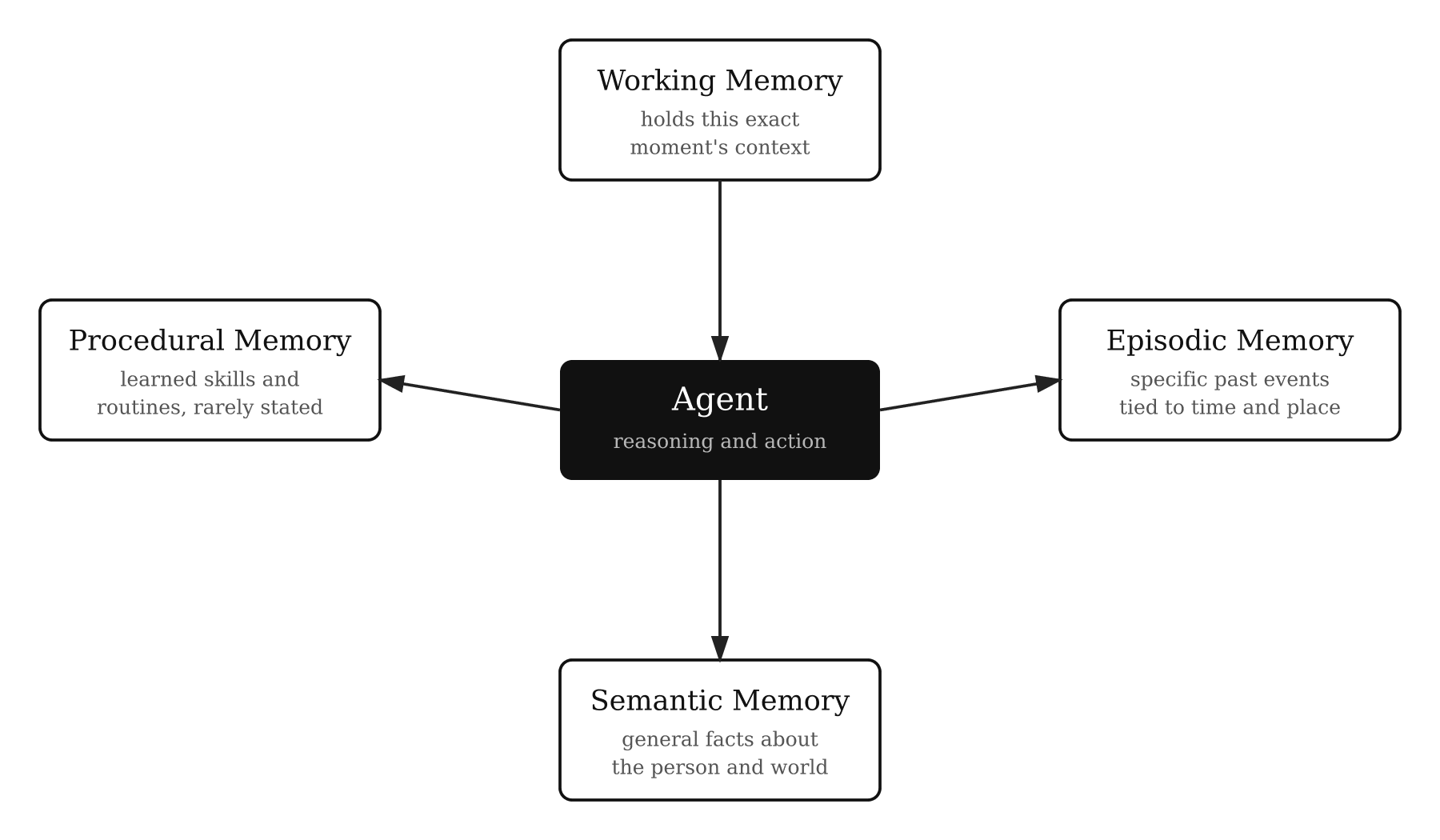
Fig. 1 — Working memory feeds the agent moment to moment; episodic, semantic, and procedural memory feed it everything that persists beyond the moment.
Most of the discussion around “AI memory” today is really about the boundary between the first two: what stays in working memory for a single session, and what gets promoted into something that survives after the session ends.
The Context Window Is Not Memory
This is worth stating plainly, because it's one of the most common points of confusion in how people talk about AI systems today: a large context window is not the same thing as memory.
A context window is capacity. It determines how much of the current conversation, this session's working memory, the system can hold onto before older parts start falling out the back. A bigger window means a bigger buffer. It does not mean anything is being kept.
Memory, in the sense that matters, is persistence. It's the deliberate act of writing something to a store that survives after the session ends, so it can be retrieved in a completely different session, days or weeks later, once the original context window has long since been cleared.
Conflating the two leads to a real design trap. A system with a very large context window can feel like it remembers, right up until the conversation ends. Close the session, start a new one, and all of it is gone, not because anything failed, but because nothing was ever written anywhere durable in the first place. Nothing was forgotten. Nothing was stored to begin with.
A bigger context window doesn't solve memory. It only postpones forgetting, and it does so unpredictably, since the person using the system usually has no visibility into when the buffer will start dropping earlier parts of the conversation.
Real memory requires the second half of the loop in Fig. 2: a deliberate consolidation step, a store outside the conversation itself, and a retrieval step that pulls the right pieces back in later. Without that, no amount of context window size adds up to a system that actually remembers.
Memory in the Loop
Memory doesn't sit beside the agentic loop. It's woven into it.
Every time the agent perceives something new, that information first lands in working memory. From there, a decision has to be made, explicitly or implicitly, about whether it's worth keeping past this moment. Most of it isn't. A passing detail that has no bearing on anything later gets discarded, and that's by design, not by failure.
What does get kept is consolidated into a longer-term store. And on every subsequent cycle, before the agent plans its next action, it retrieves whatever's relevant from that store and folds it back into the moment.
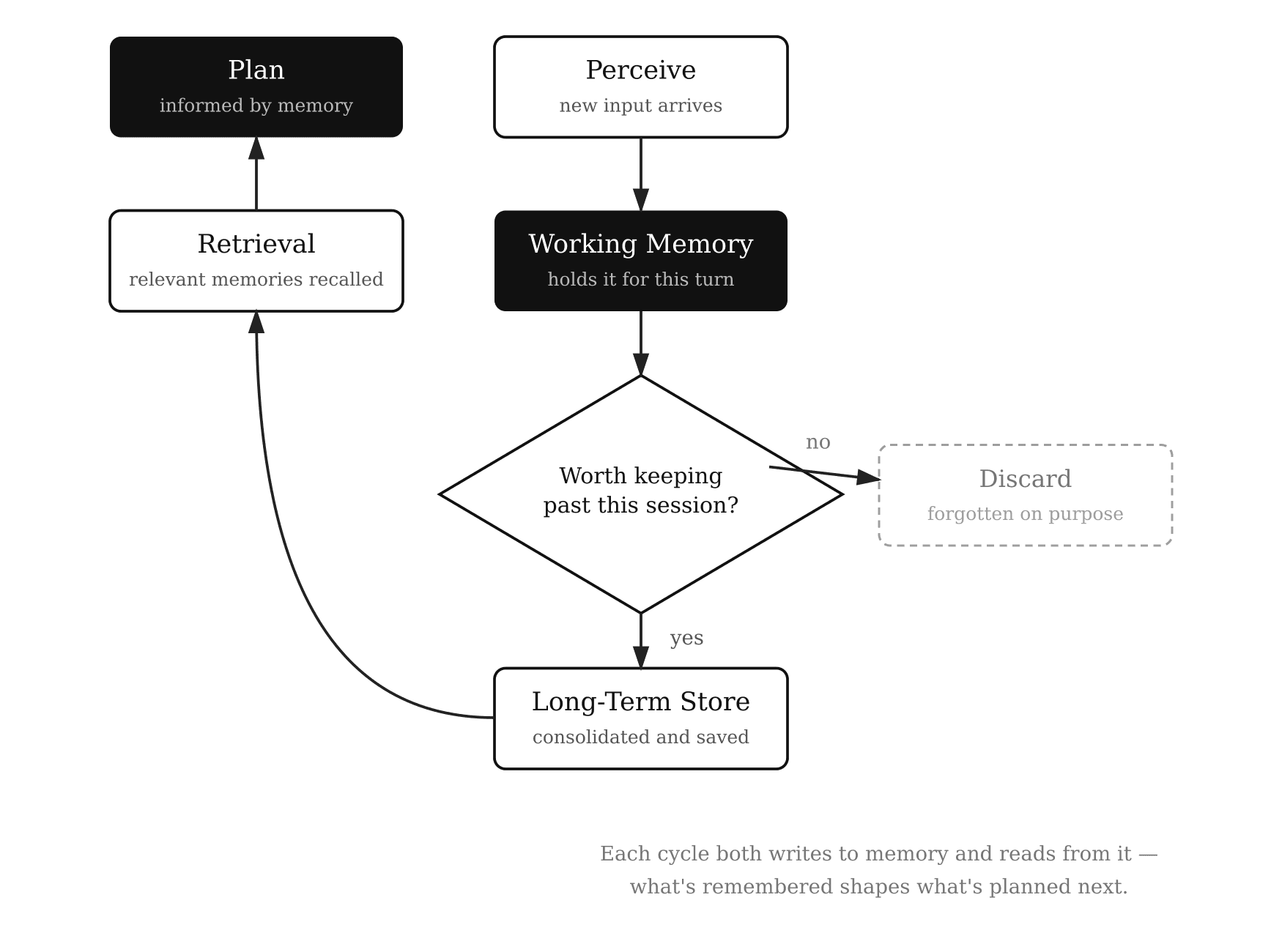
Fig. 2 — Memory is written to and read from on every cycle. What gets remembered quietly shapes what gets planned next.
This is the part that's easy to underestimate: an agent's memory doesn't just store the past, it actively steers the future. A system that remembers a person startles at loud sounds will route around construction sites before being asked. A system that remembers someone always double-checks appointment times will proactively confirm them. None of that requires new intelligence. It only requires that yesterday's episode successfully became today's context.
Why This Matters for Accessibility
For assistive technology, the value of memory isn't convenience. It's continuity.
Consider someone who relies on an assistive system throughout their day, every day. Re-establishing context each time, re-explaining a routine, a preference, a known obstacle, isn't just tedious. It's a tax that a person without a disability never has to pay to get through their own day.
A system with real memory removes that tax. It already knows which entrance is accessible. It already knows which route was too loud last time. It already knows that a certain kind of alert should come earlier, because this person needs more lead time to react.
That's not a system being smarter in the moment. It's a system that has actually been paying attention over time, the way a person who knows you well does.
The Trust Problem
Memory raises the stakes on trust in a different way than autonomy does.
An agent that acts on a wrong belief makes a mistake once. An agent that remembers a wrong belief can repeat that mistake indefinitely, confidently, without ever encountering a reason to question it.
There's also a sharper question underneath all of this: memory means the system is keeping a record of a person, potentially a detailed one, over a long period of time. That record has to be something the person can see, correct, and delete. A memory system that can't be inspected or edited isn't just a technical risk. It's a system quietly accumulating authority over someone's own history without their say in it.
This is why forgetting deserves as much design attention as remembering. A system that never forgets anything isn't more capable, it's just more brittle, holding onto stale context long after it stopped being true. Deciding what to let go of is not a lesser feature than deciding what to keep.
Designing Memory Around People, Not About Them
There's a version of agent memory that quietly turns into surveillance: a system that logs everything, infers everything, and never asks.
That's not what good memory design looks like.
Good memory design is selective. It keeps what genuinely helps and lets go of what doesn't. It's transparent, so a person can always see what the system believes about them, and correct it when it's wrong. And it's revocable, so nothing remembered is remembered forever without consent.
The measure of a well-designed memory system was never how much it stores.
It's whether the person it remembers would recognise themselves in what it recalls.
Looking Ahead
Agentic AI gave systems the ability to act without being asked at every step. Agent memory gives them the ability to act with the benefit of everything that came before.
Together, they start to resemble something less like a tool and more like a companion that's actually been paying attention.
Done well, that continuity could mean fewer repeated explanations, fewer overlooked patterns, systems that understand a person a little better with each passing day.
Done carelessly, it could mean systems that hold onto details nobody agreed to share, or that quietly fixate around a version of someone that's no longer accurate.
The difference, as always, comes down to design choices made early, not capability discovered later.